Accelerate Pancreatic Cancer Therapeutic Discovery
Industry-leading prostate cancer PDX models, matched patient-derived organoids, and ex vivo tissue platforms—designed to overcome treatment resistance and de-risk KRAS and PDAC programs. Request a consultation to discuss custom study design.
Why Partner With Crown Bioscience for Pancreatic Cancer Drug Development?
PDAC is defined by a dense desmoplastic stroma, profound immunosuppression, and near-universal KRAS oncogene addiction — features that have historically made it one of the most difficult tumor types to model and treat. Standard cell-line xenografts fail to recapitulate the complex tumor microenvironment (TME) that drives resistance to chemotherapy and immune checkpoint inhibitors alike.
Translational failure rates remain high. The path to better outcomes begins with choosing the right model.
The Most Comprehensive Pancreatic Cancer Preclinical Platform
Crown Bioscience offers an end-to-end suite of pancreatic cancer models — from rapid in vitro screening to fully immune-competent in vivo studies — all backed by deep genomic annotation and expert scientific support.

Daraxonrasib benchmark data across 100+ models (X PDAC) so you can contextualize your compound and build a differentiated story without generating reference data yourself.

PDX, matched organoids, KPC homografts, GEMMs, and cell line panels all annotated for KRAS mutation status and key co-alterations including TP53, SMAD4, and CDKN2A.

Matched PDXO and PDX pairs from the same patient let you screen in vitro and confirm in vivo in genetically concordant models, with organoid studies completing in weeks.

KPC homografts retain KRAS G12D, TP53 loss, desmoplastic morphology, and ICI resistance, making them the gold standard for IO combination and stromal-targeting studies.

WES, RNA-seq, proteomics, spatial biology, and custom PK/PD assays across the full PDAC portfolio, ready to support biomarker discovery and patient stratification.

Models evaluated with gemcitabine, nab-paclitaxel, FOLFIRINOX, and daraxonrasib so you can benchmark your candidate against current and emerging standards of care from day one.
Benchmark Your Program Against the Emerging KRAS Landscape
Daraxonrasib has become an important reference point in pancreatic cancer drug development. With benchmark data already generated across 100+ PDAC models, Crown Bioscience helps clients compare compound performance, identify differentiated response patterns, and strengthen preclinical positioning.
Utilize our PDAC model portfolio with daraxonrasib data to move faster in evaluating activity, prioritizing combinations, and building a compelling data package for internal decision-making and external stakeholders.
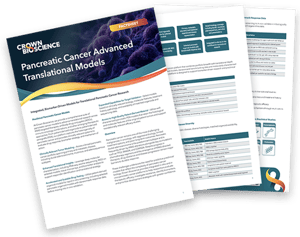
Drawing on Crown Bioscience’s deep pancreatic cancer expertise, including a portfolio of 100+ translational models and daraxonrasib benchmarking data, our speakers discuss how to bridge the gap between early preclinical discovery and more confident therapeutic decision-making.
Rekha Pal, PhD and Marten Hornsveld, PhD highlight how integrating pancreatic cancer organoids and in vivo models enables:
- Rapid Translational Screening: Utilizing patient-derived pancreatic cancer organoids to evaluate therapeutic sensitivity, support responder analysis, and prioritize candidates in a biologically relevant in vitro setting.
- Predictive In Vivo Validation: Leveraging pancreatic cancer in vivo models to assess efficacy, response durability, resistance mechanisms, and biomarker-linked outcomes in complex physiological contexts.
- Actionable Benchmarking Data: Showcasing daraxonrasib benchmarking data and Crown Bioscience’s broad pancreatic cancer portfolio to help researchers compare modalities, refine model selection, and advance KRAS-targeted, ADC, and combination strategies with greater confidence.
Matched patient-derived organoids enable rapid in vitro screening and can be paired with corresponding PDX models for stronger translational continuity.
Our PDAC PDX collection supports in vivo efficacy studies, resistance modeling, and biomarker research across clinically relevant molecular subtypes.
GEMMs support mechanistic studies, pathway biology, and resistance research in genetically defined pancreatic cancer settings.
Pancreatic Cancer Services Tailored for Therapeutic Modalities
Utilize specialized preclinical assays designed for today's most advanced pancreatic cancer therapeutic modalities. Whether evaluating antibody-drug conjugates, KRAS-targeted therapies, stromal-targeting agents, immuno-oncology combinations, chemotherapy combinations, or targeted protein degraders, our platform provides the molecular, proteomic, and target expression data needed to robustly validate efficacy, mechanism of action, and biomarker strategy.
Biomarker Guided Insights to Drive Decision- Making
Leverage integrated WES, RNA-seq, 4D-DIA proteomics, IHC, and spatial biology to define PK/PD relationships, identify patient stratification biomarkers, and elucidate response and resistance mechanisms for pancreatic cancer therapies.
Frequently Asked Questions
Crown Bioscience offers a broad portfolio of pancreatic cancer models, including patient-derived xenografts, matched patient-derived organoids, KPC syngeneic homografts, genetically engineered mouse models, cell line panels, and ex vivo patient tissue platforms.
Yes. Our pancreatic cancer portfolio includes models annotated for KRAS mutation status and key co-alterations such as TP53, SMAD4, and CDKN2A, enabling more precise study design and biomarker strategy.
Yes. Crown Bioscience has daraxonrasib benchmark data across 100+ pancreatic cancer models, helping clients contextualize compound activity, compare response patterns, and strengthen preclinical positioning.
Yes. Our pancreatic cancer platform supports ADC programs through efficacy studies, biomarker analysis, target expression profiling, and translational services designed to evaluate mechanism of action and responder biology.
Yes. Crown Bioscience offers matched patient-derived organoid and PDX pairs from the same patient, allowing teams to screen compounds in vitro and confirm findings in vivo within a biologically aligned framework.
Yes. We offer integrated biomarker services including WES, RNA-seq, proteomics, IHC, spatial biology, and PK/PD analysis to support patient stratification, resistance analysis, and translational decision-making.
Yes. Our pancreatic cancer platform includes immune-competent models such as KPC syngeneic homografts that are well suited for evaluating immuno-oncology combinations and stromal-targeting approaches.
We support a range of pancreatic cancer therapeutic modalities, including KRAS-targeted therapies, ADCs, immuno-oncology combinations, stromal-targeting agents, chemotherapy combinations, and other emerging targeted approaches.
Yes. We provide integrated in vitro and in vivo capabilities, including organoid screening, cell-based assays, PDX studies, syngeneic models, and translational profiling to support end-to-end preclinical development.
Crown Bioscience helps accelerate development by combining clinically relevant models, benchmark datasets, biomarker expertise, and flexible study design support so clients can make faster and more informed decisions.
Advance Your Pancreatic Cancer Program with Confidence
Ready to advance your pancreatic cancer program? Our scientific team is here to help you design the right study — from model selection to biomarker strategy.