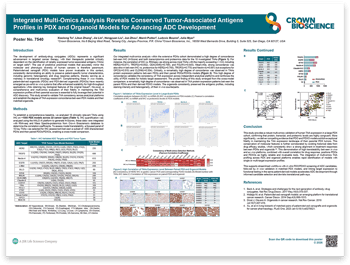
Discover how an integrated multi-omics approach is being used to identify and validate Tumor-Associated Antigens (TAAs) across patient-derived models. This research addresses the critical need for reliable preclinical models that accurately reflect the complex protein expression found in human tumors.
By analyzing a vast collection of Patient-Derived Xenograft (PDX) and Patient-Derived Organoid (PDO) models, the study highlights how these systems maintain the genomic and proteomic profiles of the original patient tissues.
The analysis utilized transcriptomics and proteomics to map TAA expression across various cancer types, including lung, colorectal, and breast cancers. The findings confirm that these models serve as a highly conserved resource for testing Antibody-Drug Conjugates (ADCs), ensuring that the targets identified in the lab are truly representative of what will be encountered in clinical settings. This high-throughput platform enables the precise selection of models based on specific antigen levels, significantly accelerating the development of targeted cancer therapies.
-
Access Large-Scale Data: Review expression profiles of major ADC targets (such as HER2, TROP2, and CEACAM5) across more than 500 PDX models and 150 organoid models.
-
Validate Model Fidelity: Examine evidence demonstrating the high correlation in TAA expression between original patient tumors and their corresponding lab-grown models.
-
Optimize Target Discovery: Learn how combining mRNA and protein data provides a more accurate assessment of "targetable" antigens compared to using a single data type alone.
-
Enhance Experimental Design: Gain insights into a searchable "Target Library" that allows researchers to select the most relevant preclinical models for specific ADC candidates.