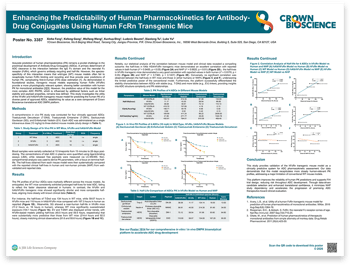
This research validates that using hFcRn and hAlb/hFcRn transgenic mice—which express human-specific receptors—provides a much more reliable correlation with clinical data. By testing four approved ADCs with diverse designs, the study demonstrates that these advanced models can successfully account for the structural complexities of ADCs, such as linker stability and payload behavior, ensuring safer and more efficient drug development.
-
Improve Predictive Accuracy: Learn how transgenic models achieved an excellent correlation (r2=0.9485) with human half-life values compared to conventional models.
-
Access Benchmarking Data: View detailed PK profiles and half-life comparisons for four major approved ADCs: T-DXd, T-DM1, SG, and EV.
-
De-Risk Clinical Entry: Understand how to utilize this platform to support first-in-human dose estimation and reduce dependency on non-human primate (NHP) studies.
-
Evaluate Linker Stability: Gain insights into how different ADC designs, including stable versus labile linkers, impact drug clearance across multiple biological systems.