AACR 2026 Poster 4515
Clinically Relevant AML Modeling with In Vitro Bone Marrow Niche and In Vivo PDX Approaches
Talita Stessuk, Hanna Vermeer, Afsaneh Golestani, Jolie Flach, Jessie Wang, Qingzhi Liu, Jinping Liu, Gera Goverse, Marrit Putker, Ludovic Bourre
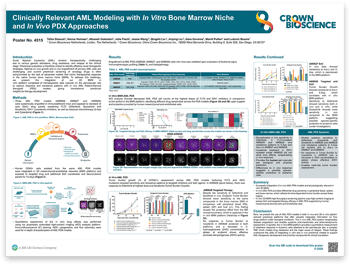
Discover how integrated in vitro and in vivo AML models capture drug response and resistance mechanisms within the protective bone marrow microenvironment.
Acute Myeloid Leukemia (AML) remains therapeutically challenging due to genetic heterogeneity, drug resistance, and high relapse rates. This study demonstrates how combining patient-derived xenograft (PDX) models with a physiologically relevant 3D bone marrow niche (BMN) platform provides complementary insights into therapeutic efficacy. By integrating systemic in vivo pharmacology with high-content imaging of leukemic cells within the human perivascular niche, this approach reveals how the tumor microenvironment drives resistance—bridging the gap between preclinical drug screening and clinical translation in hematologic malignancies.
Download this Poster to Discover:
- Evaluate drug responses across complementary model systems: Compare sensitivity patterns between in vivo AML PDX models and in vitro 3D BMN co-cultures across multiple targeted therapies and standard-of-care agents.
- Capture microenvironment-mediated resistance: Understand how the human bone marrow perivascular niche provides biological and physical protection to leukemic cells, revealing resistance mechanisms missed in suspension culture systems
- Assess FLT3 and IDH1 inhibitor activity: Visualize differential responses to Gilteritinib, Quizartinib, Sorafenib, and Ivosidenib across genetically characterized AML PDX models harboring clinically relevant mutations.
- Quantify multi-site tumor burden dynamics: Leverage high-content imaging and flow cytometry to track treatment effects across peripheral blood, spleen, bone marrow, and liver compartments.
- Accelerate translational AML research: Learn how integrated in vitro and in vivo platforms support compound prioritization and reveal species-specific versus microenvironment-driven protection mechanisms.
Download the Poster Now!