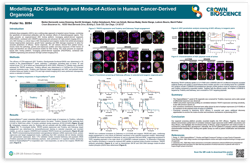
AACR-NCI-EORTC 2025 Poster B094
Modelling ADC Sensitivity and Mode of Action in Human Cancer Derived Organoids
Marten Hornsveld, Lenno Krenning, Dorrith Verstegen, Caitlyn Hulsebosch, Peter van Schaik, Mariusz Madej, Hester Bange, Ludovic Bourre, Marrit Putker

In this study, Crown Bioscience presents an advanced organoid-based ADC testing platform that combines patient-derived organoids (PDO/PDXO), CRISPR engineering, and 3D high-content imaging (HCI). This approach enables accurate, functional assessment of ADC efficacy, target engagement, and resistance mechanisms—beyond what can be inferred from biomarker expression alone.
Download this Poster to Discover:
- Functional Screening with OrganoidXplore™: Evaluate the activity of the FDA-approved ADC Trodelvy (Sacituzumab Govitecan/SN-38) across 50 organoid models spanning seven cancer types, characterized by genomics (WES, RNAseq) and target expression.
- Decoupling Target Expression and Sensitivity: See how responses to Trodelvy varied widely across models and were not directly correlated with TROP2 mRNA or protein levels, emphasizing the importance of functional testing.
- Mechanistic Insights into Resistance: Explore how TROP2 knockout and payload resistance studies revealed distinct mechanisms driving non-responsiveness, ranging from epitope loss to payload-specific DNA damage resistance.
- 3D High-Content Imaging Applications: Learn how advanced imaging techniques quantify ADC binding, uptake, and phospho-γH2AX DNA damage responses, enabling precise evaluation of drug mechanism and potency.
- Predictive Preclinical Platform: Leverage organoid-based assays for patient stratification, biomarker discovery, and ADC optimization to accelerate the development of next-generation targeted therapies.
Download the Poster Now!