Poster P01.03: KPC Homograft Models for PDAC Combination Immunotherapy Development
Establishment of Kras (G12D)/Trp53 null/Pdx1-cre (KPC) Mouse Homograft Tumor Models to Facilitate Preclinical Efficacy Evaluation of Combinatory Immunotherapies
Lily Tong, Yanrui Song, Benqi Liu, Jessie Wang, Hongyan Sun, Annie Xiaoyu An, Likun Zhang, Jie Cai, Qian Shi, Jean-Pierre Wery, and Davy Xuesong Ouyang
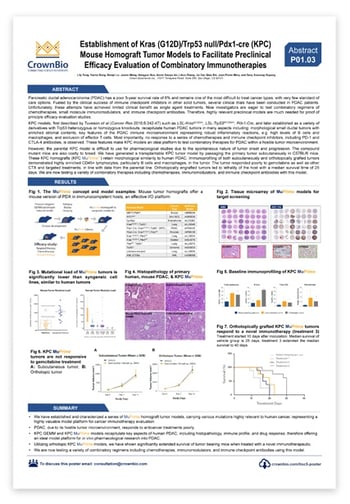 Pancreatic ductal adenocarcinoma (PDAC) has a poor 5-year survival rate and remains one of the most difficult to treat cancer types, partially due to a lack of standard of care treatment options. While immunotherapeutics have been trialed in PDAC patients, they have had limited success as single agents, creating a need for immuno-oncology models for evaluating combination regimens.
KPC models recapitulate human PDAC tumors in many aspects, importantly including a lack of response to a range of treatments including chemotherapy and immune checkpoint inhibitors, such as anti-PD-1 and PD-L1 antibodies. However, the parental KPC model is difficult to use for efficacy studies due to the spontaneous nature of tumor onset and progression.
CrownBio has therefore developed a transplantable KPC tumor model by passaging the primary tumor subcutaneously in C57BL/6 mice. The model retains morphological similarity to human PDAC, as well as a poor response to chemotherapy and targeted agents, providing an ideal model platform for in vivo pharmacological research into PDAC.
Read this Poster to Discover:
- The establishment and characterization of a panel of homograft tumor models, carrying various mutations highly relevant to human cancer, including PDAC, for immunotherapy evaluation
- That, despite a poor response to chemotherapy and targeted agents, mice bearing the orthotopic KPC homograft model show significantly extended survival following treatment with a novel immunotherapeutic
- That KPC homograft models, recapitulating key aspects of human PDAC including histopathology, immune profile, and drug response, offer a highly relevant platform for testing a variety of combinatory regimens including chemotherapies, immunomodulators, and immune checkpoint antibodies
Download the Poster Now!