
<img height="1" width="1" src="https://www.facebook.com/tr?id=1582471781774081&amp;ev=PageView &amp;noscript=1">

Syngeneic Tumor Models

Evaluate your immunotherapies and fast-track in vivo screening

Large Panel of Validated Syngeneic Models Ready for Your Immunotherapy Evaluation

Preclinical research of new immunotherapies requires in vivo models with fully functional immunity. Syngeneic tumor models are homografts derived from immortalized mouse cancer cell lines which originated from the same inbred strain of mice. This provides simple models with fully competent immunity for assessing your new single agent and combination immunotherapies.

Evaluation of Anti-PD-1 Efficacy

Our syngeneic models are well-characterized, making them the ideal models to evaluate your novel immuno-oncology agents as well as combination therapies.

The extensive characterization data found within our searchable database MuBase® includes immune checkpoint inhibitor benchmarking (including model response to anti-PD-1, PD-L1, and CTLA-4) and tumor RNAseq. Baseline tumor immunoprofiling and post-ICI treatment tumor immunoprofiling is also available for a subset of our models with further characterization ongoing.

Well Validated Models
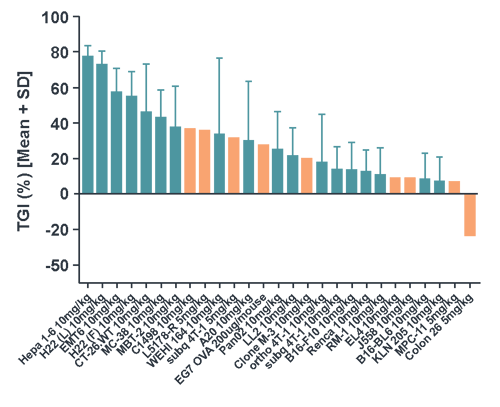
Chart demonstrating well-validated models.

Explore Our Collection

We provide a large collection of syngeneic models covering a variety of cancer types and immune phenotypes, available now for your efficacy and PD studies.

Subcutaneous Models

pdx-icon-bladder
Bladder

MBT-2

pdx-icon-breast
Breast

4T1, EMT6, JC

fibrosarcoma-icon-small
Fibrosarcoma

WEHI-164

pdx-icon-brain
Glioma

GL261-luc

pdx-icon-kidney
Kidney

Renca

pdx-icon-all
Leukemia

C1498

pdx-icon-liver
Liver

H22, Hepa 1-6

myeloma-icon-small
Myeloma

MPC-11, P3X63Ag8U.1

ms-icon-small
Neuroblastoma

N1E-115, Neuro-2a

pdx-icon-pancreatic
Pancreatic

Pan02

plasmacytoma-icon-small
Plasmacytoma

J558

pdx-icon-prostate
Prostate

RM-1

Orthotopic Models

pdx-icon-breast
Breast

4T1, EMT6

pdx-icon-brain
Glioma

GL261-luc

pdx-icon-liver
Liver

Hepa 1-6

pdx-icon-pancreatic
Pancreatic

Pan02

Systemic Models

pdx-icon-lung
Leukemia

C1498

myeloma-icon-small
Myeloma

MPC-11

Specialty Models

pdx-icon-breast
Breast

4T1 (metastatic/ bioluminescent)

pdx-icon-liver
Liver

H22 (bioluminescent) Hepa 1-6 (bioluminescent)

pdx-icon-brain
Glioma

GL261-luc (bioluminescent)

pdx-icon-lung
Lung

LL/2 (LLC1) (metastatic)

pdx-icon-melanoma
Melanoma

B16-F-10 (metastatic), B16-BL6 (metastatic)

Advanced Models for Metastatic Modeling and Optical Imaging 

We provide syngeneic models of metastasis as well as orthotopic and bioluminescent models. This allows you to study clinically relevant metastatic invasion, metastatic lesions in secondary organs, and to evaluate your agents which target metastasis.

Our orthotopic models provide a tumor microenvironment more comparable to the patient. The tumors form at organ-specific sites, facilitating metastatic spread, and supporting immune and stromal component interactions.

Our bioluminescent imaging (BLI) capabilities enable non-invasive longitudinal monitoring of orthotopic tumor burden. This provides you with optimal randomization, reduction of false positives, and continuous feedback, supporting the most appropriate treatment regimens mid-study.

Discover Large Scale In Vivo Screening for Immunotherapeutics 

Fast-track the screening of your novel immunotherapeutics with MuScreen™, our large-scale, in vivo screening platform for cancer immunotherapeutics.

MuScreen can improve efficiency and save you study time by helping you to rapidly identify the right markers and models for your preclinical programs. Evaluate your agent's TGI and PD effects with either the Syngeneic Efficacy or PD Screening Panel of 6 or 12 models.

Discuss Your Syngeneic Tumor Models Project